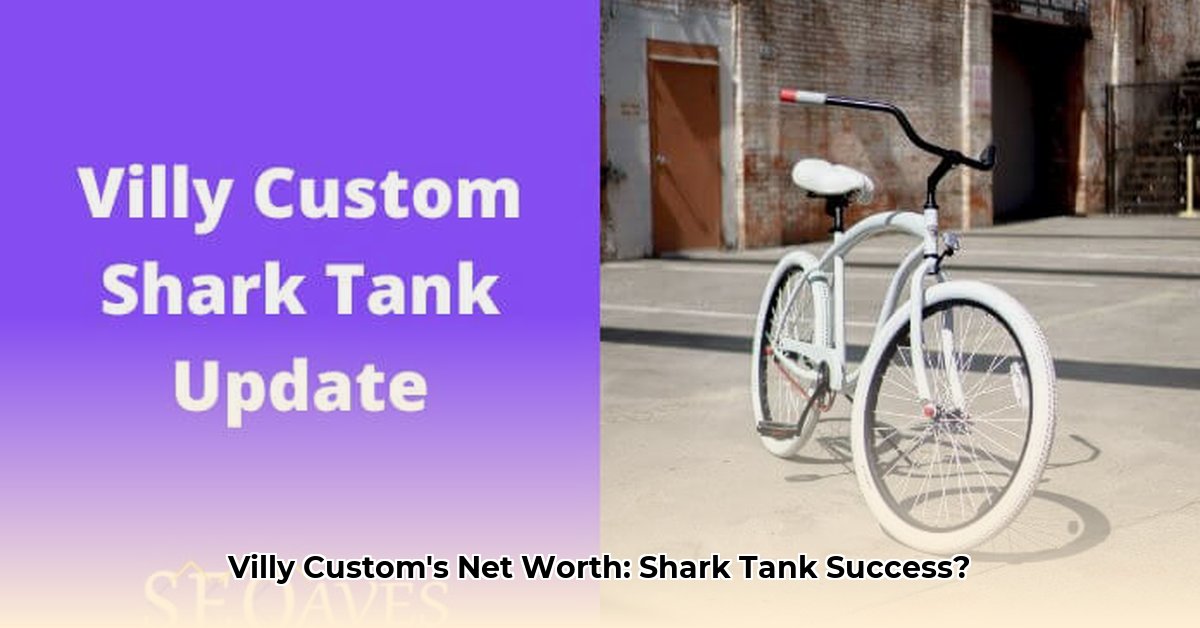
Villy Custom's Shark Tank appearance dramatically altered its trajectory. The resulting surge in brand awareness and sales propelled its estimated net worth to between $2.75 and $3 million, with annual revenue reaching an impressive $4 million. However, a precise valuation remains elusive due to a lack of publicly available financial details. For more on similar success stories, check out this Shark Tank net worth analysis. This case study analyzes Villy Custom's post-Shark Tank performance, examining its growth trajectory, inherent challenges, and strategic pathways for sustained success.
Riding the Wave: Analyzing Villy Custom's Post-Shark Tank Growth
The immediate post-Shark Tank period witnessed exponential growth for Villy Custom. Sales soared, exceeding pre-Shark Tank levels by a significant margin. This surge underscores the power of the show as a brand accelerator. High-profile partnerships with major brands like Google and Nike further solidified Villy Custom's position within the luxury bicycle market. However, this rapid expansion raises crucial questions about long-term sustainability. Can Villy Custom organically maintain this momentum without relying solely on the initial Shark Tank effect?
Navigating the Landscape: Challenges in the Luxury Bicycle Market
The luxury, custom-built bicycle market, while lucrative, is inherently niche. This presents both opportunities and challenges. The exclusive nature of the market limits potential customer base, but it also allows for premium pricing and strong brand building. However, maintaining this level of growth requires strategic planning and the ability to adapt to market fluctuations. Several key challenges stand out:
- Market Saturation: The limited market size increases the risk of saturation, making expansion into new segments crucial.
- Competition: The high-end bicycle market is increasingly competitive, requiring ongoing innovation and distinct brand positioning.
- Operational Efficiency: Scaling operations requires streamlined processes to maintain production efficiency and manage costs effectively.
- Financial Volatility: The dependence on high-value sales creates inherent financial volatility, necessitating robust financial planning.
Charting a Course for Success: Strategic Roadmaps for Villy Custom
Sustained success requires a multi-faceted strategy focusing on both short-term gains and long-term vision. This involves clear action plans for key stakeholders:
Fleetwood Hicks (Owner):
- Short-Term (0-12 Months): Implement strategies to enhance profit margins by optimizing production, negotiating favorable supplier deals, and streamlining operational processes.
- Long-Term (3-5 Years): Explore diversification by expanding into related markets, such as high-end cycling apparel or accessories, to leverage brand recognition and capitalize on cross-selling opportunities.
Investors (Mark Cuban & Barbara Corcoran):
- Short-Term: Monitor key performance indicators (KPIs) meticulously, including sales figures, customer satisfaction, and marketing ROI, to assess the effectiveness of strategies. Supportive funding for marketing and expansion initiatives is essential.
- Long-Term: Develop clear exit strategies, preparing for potential acquisition or initial public offering (IPO) while continually assessing future funding needs.
Customers:
- Short-Term & Long-Term: Prioritize exceptional customer service and maintain an unwavering commitment to superior product quality. Invest in improving online customization tools and enhancing the customer's overall purchase journey.
Competitors:
- Short-Term & Long-Term: Continuous market analysis of competitor activities and strategies is crucial. Villy Custom needs to stay ahead by maintaining innovation in design, material selection, and customer experience.
Risk Assessment Matrix: Identifying and Mitigating Potential Threats
A thorough risk assessment is vital for charting a sustainable path. The following matrix outlines key risks and their mitigation strategies:
| Risk Factor | Likelihood (High/Medium/Low) | Impact (High/Medium/Low) | Mitigation Strategy |
|---|---|---|---|
| Market Saturation | Medium | Medium | Diversify product offerings; expand into new geographical markets; invest in targeted marketing campaigns. |
| Competition | Medium | Medium | Continuously innovate product design; enhance brand loyalty; offer superior customer service; focus on unique selling propositions (USPs). |
| Operational Inefficiency | Medium | Medium | Streamline production processes; invest in advanced technology; optimize supply chain management; improve internal communication. |
| Financial Volatility | Low | High | Diversify revenue streams; improve financial forecasting and budgeting; develop robust contingency plans. |
Projecting Future Profitability: A Framework for Success
Accurately projecting Villy Custom's long-term profitability requires a robust framework, incorporating the following:
- Financial Modeling: Develop comprehensive financial models incorporating various revenue projections based on historical data, market analysis, and planned marketing initiatives.
- Market Research: Conduct in-depth market research to assess the target market size, expansion potential, and competitive landscape.
- Sensitivity Analysis: Perform sensitivity analyses to assess how changes in key factors (e.g., marketing spend, competitor actions) impact profitability.
- KPI Tracking: Establish and continuously monitor key performance indicators (KPIs), including sales, customer acquisition cost (CAC), customer lifetime value (CLTV), and marketing ROI.
- Scenario Planning: Develop multiple scenarios encompassing different market conditions and business strategies to assess risk and prepare for potential challenges.
Actionable Intelligence: A Strategic Roadmap for Stakeholders
The following table summarizes actionable intelligence for key stakeholders:
| Stakeholder | Short-Term (0-1 Year) | Long-Term (3-5 Years) |
|---|---|---|
| Villy Custom | Optimize marketing, explore new channels, enhance operational efficiency | Diversify product lines, explore international markets, refine brand positioning |
| Investors | Monitor KPIs, assess ROI, refine investment strategy | Evaluate exit strategies, consider further investment rounds |
| Customers | Maintain superior service, personalize experiences | Enhance loyalty programs, foster brand community engagement |
The path to long-term success for Villy Custom hinges on strategic planning, financial transparency, and proactive risk management. While the Shark Tank effect provided a remarkable boost, sustained profitability requires a comprehensive understanding of the market, operational efficiency, and the ability to learn and innovate continuously.